
Can Small Business Owners Use The Presumptive Taxation Scheme To Simplify Their Filings?
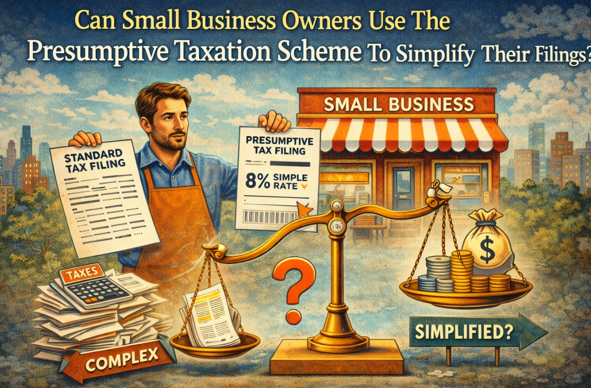
To numerous owners of small businesses, tax season each year begins not as a financial physical, but an administrative marathon. It is easy to see that between the cost involved in keeping track of every minor receipt and that involved in reconciling complex entries in ledgers, the cost of compliance can oftentimes exceed the tax obligation itself.
Here is where the Presumptive Taxation Scheme, i.e., Section 44AD and 44ADA of the Income Tax Act, comes in as a game changer. This is how you can use these provisions to make it easy when filing.
What is the core idea behind presumptive taxation?
The Presumptive Taxation Scheme will also offer the benefit of aiding small taxpayers by enabling them to report a percentage of their entire turnover as income, as opposed to the computation of real profits. Experienced IRS tax experts (former IRS tax agent, former auditor, and experienced IRS tax attorney from San Francisco) or other places can help with the taxation.
By making the option, the government assumes your profit over your revenue, therefore eliminating the burden of keeping exhaustive books of accounts or holding regular audits.
Who is eligible to use this simplified scheme?
This is not a shortcut that can be used by any entity. The plan is specifically designed to suit:
Resident Natural persons, HUFs, and Partnership Firms (except LLPs).
Small Businesses: Small Businesses that have a turnover of at most 2 crore (when cash receipts are 5% or less of total revenue), 3 crore.
Individuals (such as lawyers, doctors, or engineers) who have gross receipts in the range of 50 lakh (and 75 lakh in case of a cash receipt).
See also: How Businesses Verify Proof of Address in Customer Onboarding
How does it simplify the actual filing process?
With a normal tax regime, you are required to have a profit and loss account, a balance sheet, and evidence of all the expenses incurred. In the presumptive scheme:
- No Bookkeeping: You are entitled by law to have no detailed books of account in order to comply with Section 44AA.
- Profit proclaimed: The companies report a profit of 8% of the turnover (which becomes 6% in the case of the e-transactions in order to promote a cashless economy).
- Single Advance Tax Payment: Rather than remitting advance taxes in four installments during the quarter, presumptive filers are required to remit the full payment as a single installment by March 15 th.
Are there any downsides for business owners to consider?
The objective is simplicity, however, at the expense. After you choose this scheme, you will not be able to deduct any additional business expenses or depreciation any more. The profit margin of 8/6 percentage is final. Experienced IRS tax experts (former IRS tax agent, former auditor, and experienced tax assessment attorney) who can help to minimize the downsides.
Assuming that you make an actual business profit of much less than 8% of total sales, in other words, the actual business expenses are very high, you may pay the tax beyond what is necessary. More so, you are not allowed to enter into the scheme again within a period of the next five years when you decline the scheme in any year.
Can professionals also benefit from these simplified filings?
Yes. Section 44ADA provides that specific professions (legal, medical, engineering, etc.) are entitled to state 50% of their gross receipts as their taxable income. It is absolutely so useful when it comes to consultants or freelancers who incur low overhead expenses yet do not wish to be bothered by the hassle of keeping track of all software subscriptions or office supplies purchases.
Conclusion
The Presumptive Taxation Scheme is the most efficient scheme of the Tax relief opportunities suggested to the small owners of businesses to achieve the reduction of administrative stress. It compromises the accuracy offered by manual accounting with the speed of a flat-rate computation.
It is, however, a strategic move; it is suitable with the companies that have a high profit margin or whose time spent in accounting is more valuable than the deductions that are likely to be sacrificed.